
The journal
Flying with a CPAP: bag, battery and power
How to fly with a CPAP: carry it on as a medical item, get through security, use it on board, pack batteries within the limits and power it abroad.
Quick answer: can you take a CPAP on a plane?
Yes. Carry it on rather than checking it, so it cannot be lost, crushed or left cold in the hold, and so it is with you on the first night of the trip. In the United States, airlines must let passengers bring assistive devices into the cabin and may not count them toward a carry-on limit (14 CFR 382.121). Pack the CPAP in its own case and treat it as an extra item, not as part of your personal item or carry-on bag.
Outside the US, airlines set their own policies. Most accept a CPAP in the cabin, but check the medical equipment page of your airline before you fly, and look again if you change airlines on a connection.
Pack the machine for the bag, not just for the bedroom
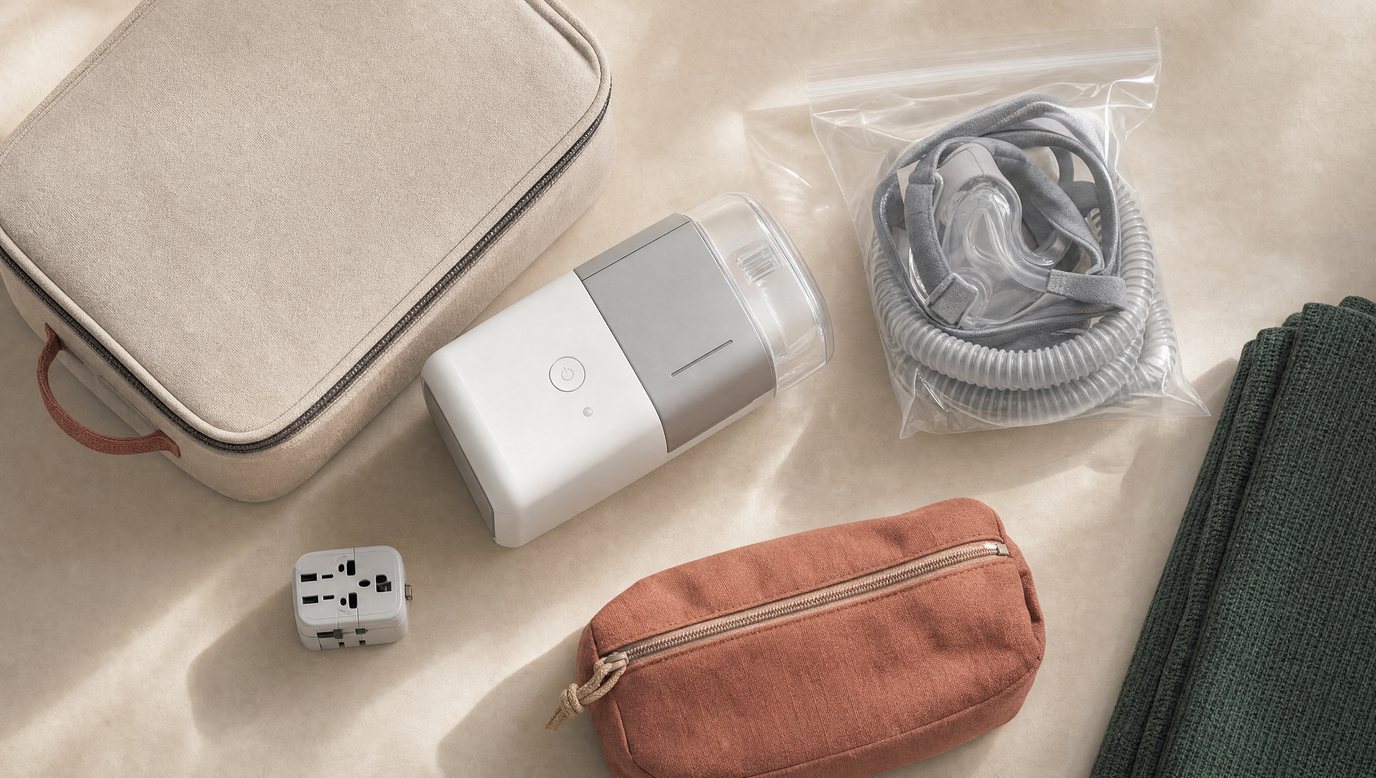
The case that came with the machine is usually the right starting point: it is padded and shaped around the device. Keep everything the machine needs to run in that one case, so it can travel as a single medical item next to your personal item and carry-on.
- Machine and power supply. The power brick and cord are the parts most often left behind in a hotel socket.
- Mask, cushion and tubing. Pack a spare cushion if you are away for more than a few nights.
- Humidifier chamber, empty and dry. Water left in the tank can leak into the machine. Plan to buy distilled water at your destination.
- Plug adapter for the country you are visiting, and a short extension lead if bedside sockets are scarce.
- A clear plastic bag for the machine at security.
- Your prescription or a note from your clinician. It is not a TSA requirement, but it can help at security or customs abroad.
At security: what comes out of the case
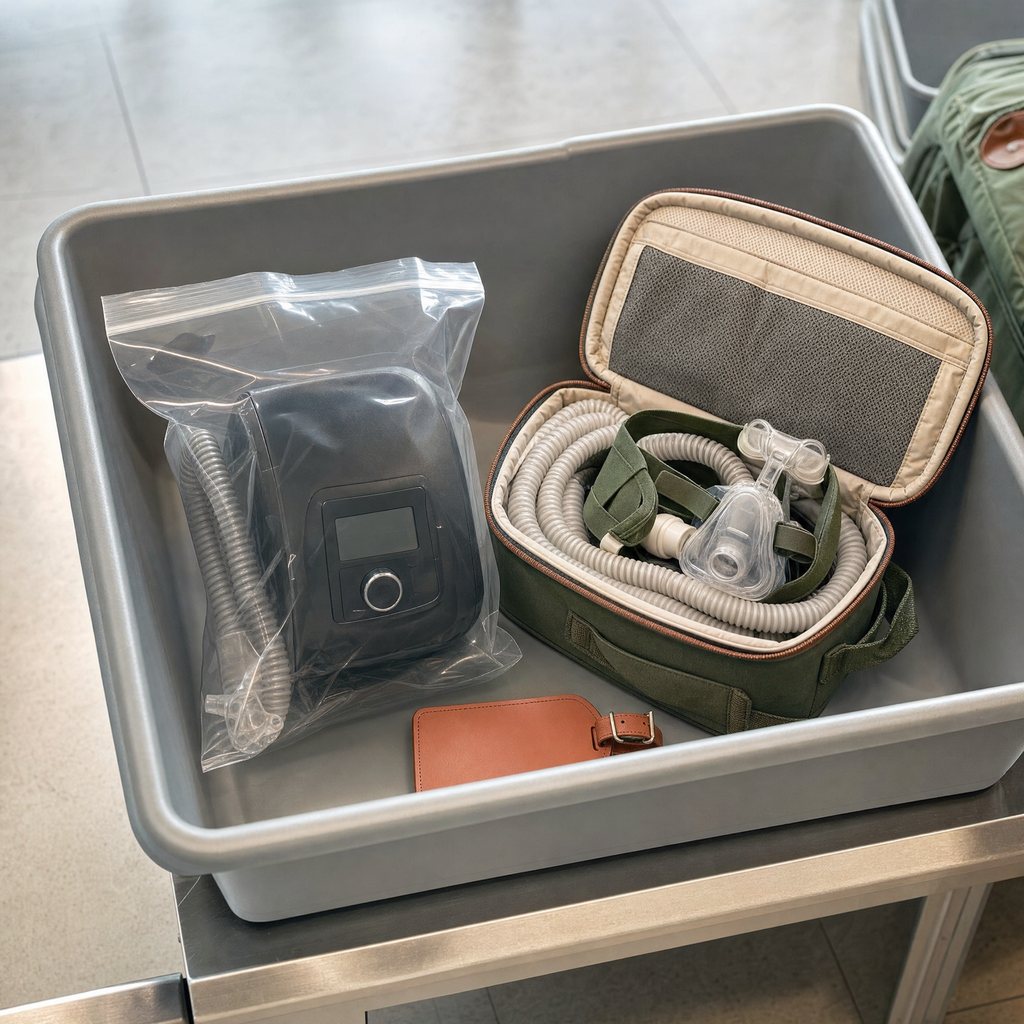
At US checkpoints the CPAP must come out of its carrying case and go through the X-ray on its own; the mask and tubing may stay in the case. You can put the machine in a clear plastic bag to keep it clean in the bin. With TSA PreCheck, the machine, mask and tubing can usually stay in the case and in your bag (TSA: CPAP machines).
If you carry distilled water, it counts as a liquid. Medically necessary liquids above the 3.4 oz or 100 ml limit are allowed but must be declared to the officer for screening (TSA liquids rule). Buying distilled water after you land is usually simpler, and our guide to packing liquids in a carry-on covers the rest of the quart bag.
Using the CPAP during the flight
On a long overnight flight you may want to use the machine in your seat. US and foreign airlines flying to or from the US must allow it when the device carries the manufacturer's label saying it meets the FAA's requirements for medical portable electronic devices (14 CFR 382.133). The airline may ask for:
- Advance notice of 48 hours, and check-in one hour before the check-in time for other passengers.
- Enough batteries for the flight. The airline tells you the expected maximum flight duration; you bring enough battery power for it. Seat power is not guaranteed and is not a substitute.
- Protected spare batteries, packed so the terminals cannot short.
The US Department of Transportation explains these rules in its guidance on respiratory devices on aircraft. Ask your airline in writing what it needs, and keep the reply with your boarding pass.
For the rest of the night on board, our overnight flight sleep kit covers masks, earplugs and where to pack them.
Batteries: what the rules allow
| Battery rating | Cabin | Checked bag |
|---|---|---|
| Up to 100 Wh | Allowed | Not allowed as a spare |
| 101 to 160 Wh | Airline approval needed, at most two spares | Not allowed as a spare |
| Over 160 Wh | Forbidden | Forbidden |
Spare lithium batteries, including power banks, must be carried in the cabin and never in checked baggage (FAA PackSafe: lithium batteries). The watt-hour rating is printed on the battery; many airlines set stricter limits, so check both. Keep each spare in its original packaging or a protective case, or tape over the terminals.
Power at your destination
Most CPAP power supplies are rated for 100 to 240 volts and 50 or 60 Hz. With a power supply like that, you only need a plug adapter to fit the socket shape; a voltage converter adds weight and a failure point without helping. If the label shows a single voltage, you need a converter rated for the machine. Our guide to travel adapters and voltage converters shows how to read the label before you buy either.
Choosing a machine for travel is its own decision: size, weight, battery options and whether it can run without a humidifier all matter. TalkAboutSleep compares travel CPAP machines if you are deciding whether a dedicated travel unit is worth it.
CPAP travel check
Frequently asked questions
Does a CPAP count as my carry-on?
Not on US airlines: assistive devices such as a CPAP may not be counted toward a carry-on limit. Other airlines set their own rules, so check before you fly.
Can I check my CPAP instead?
TSA allows it in checked bags, but the cabin is safer: checked bags are handled roughly, can be delayed, and the machine would not be with you if the bag is lost.
Do I need a converter to use my CPAP abroad?
Usually not. If the power supply label says 100 to 240 V, a plug adapter is enough. A single-voltage label means you need a converter rated for the machine.
Can I use my CPAP on the plane?
If it carries the manufacturer's FAA label for medical portable electronic devices. Airlines may ask for 48 hours' notice and enough battery power for the flight, so contact them early.