
Map the transfers first. A rolling case reduces how much you carry on smooth surfaces; a backpack keeps your hands available but puts the load on your body. The number of stairs, walking distances and your own comfort matter more than the continent on the ticket.
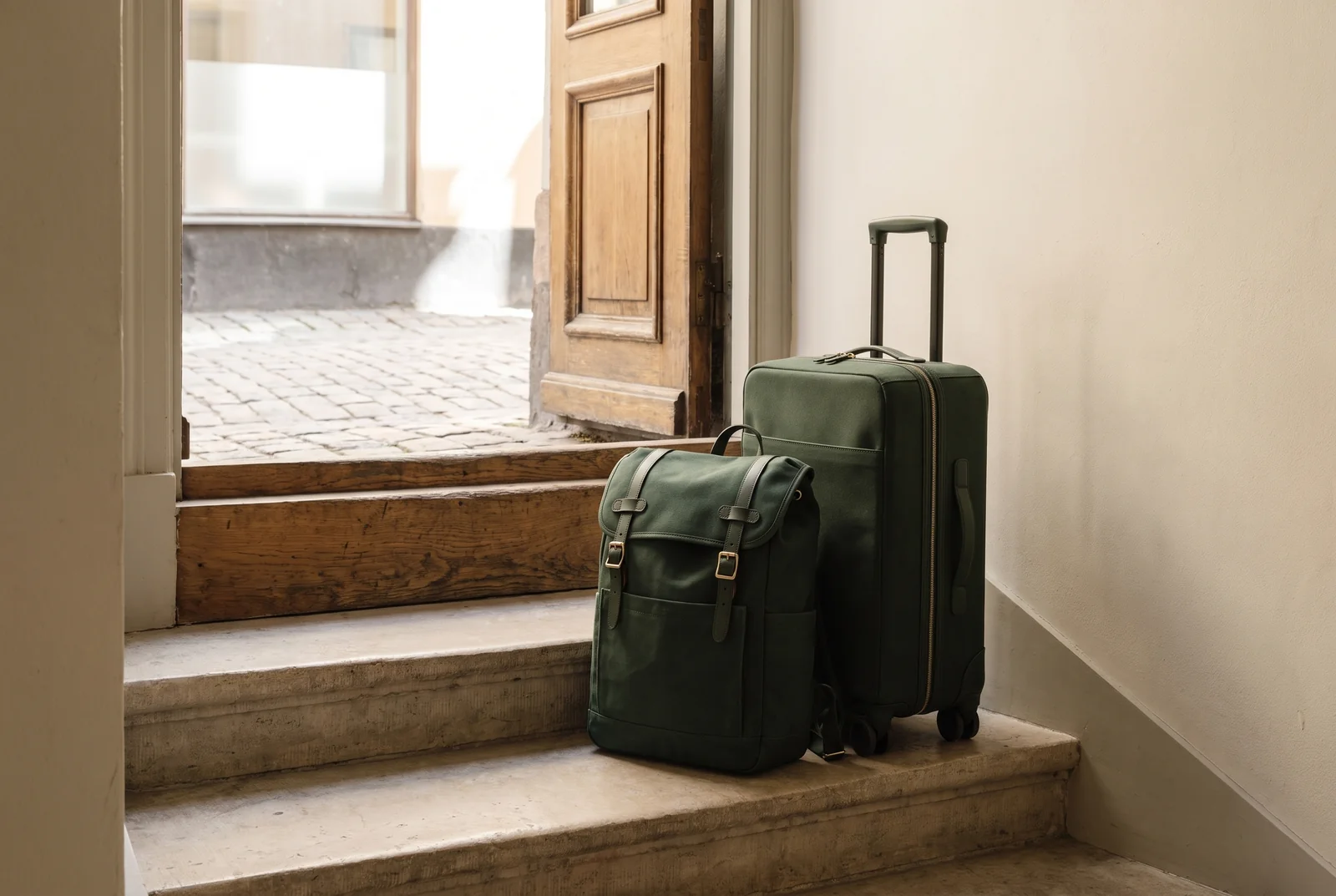
Make the comparison that matters
| Check | What it changes | Your next step |
|---|---|---|
| Station stairs | Lifting frequency | Rehearse lifting a loaded case |
| Long smooth corridors | Benefit of rolling | Try handle reach and tracking |
| Uneven pavements | Wheel handling and carrying time | Plan the actual last kilometre |
| Packed load | Comfort when worn | Walk with the travel pack loaded |
Count the awkward parts of the trip
Make a small transfer map: airport to train, train to hotel, hotel to next town. Note stairs, long walks and whether the accommodation has a lift. A week in one accessible city hotel asks different things of a bag from a week changing trains and climbing narrow staircases.
Use carrying distance to make the tradeoff
A backpack leaves both hands free but keeps the whole load on you. A wheeled case takes weight off your shoulders on a smooth surface but still needs lifting at stairs and kerbs. Neither is automatically the lighter choice: compare empty weight and the packed total, then carry or pull an equivalent load before committing.
Fit the person as well as the allowance
Travel backpacks differ in harness adjustment, back length and hipbelt design. Follow the exact manufacturer’s fitting instructions and try the load you expect to use. A litre number does not show whether the bag fits your torso or its expanded shape fits an airline sizer.
Make one deliberate compromise
For a station-heavy trip, smaller luggage may be more valuable than another outfit. For a single hotel stay, easy rolling and a useful opening can win. Write the compromise down: “I accept lifting this case twice a day” or “I accept carrying this weight for each transfer.” That is more useful than choosing by continent alone.
Before you spend
Test the difficult part of the itinerary rather than the easiest. Lift a loaded case onto a luggage rack only if that is comfortably within your ability; try wearing a loaded pack for a meaningful walk at home. There is no need to buy a very large travel pack for a small packing list. Match the carrying system and usable capacity to your own requirements.
A useful finishing check
No. Conditions vary between routes and locations. Four wheels are convenient on smooth surfaces; rough sections may require tilting or carrying the bag. Consider wheel design, handle comfort, lifting and the actual route instead of treating every European street as the same surface.
ILLUSTRATIVE EXAMPLE
Put it into practice
A journey with one airport transfer and a lift-equipped hotel may suit a suitcase. A trip with several lodging changes, stairs and short walking transfers may favour a fitted backpack. Either choice becomes less pleasant when the packing list is heavier than you can comfortably manage.
Your next steps
- Map transfers: count stairs and walking
- Test the load: use realistic weight
- Choose the carry: match your comfort
Questions that come up
Is a 40 L backpack always carry-on sized?
No. Capacity does not fix its exterior dimensions, and the full load may exceed an airline’s weight limit.
What size backpack do I need for two weeks?
Start with a packing list and laundry plan. Trip duration alone does not determine a bag size.
Are four-wheel cases unusable on European streets?
No. Conditions vary between routes and locations. Four wheels are convenient on smooth surfaces; rough sections may require tilting or carrying the bag. Consider wheel design, handle comfort, lifting and the actual route instead of treating every European street as the same surface.
Sources and further reading
Source references for this edition, September 8, 2026. Recheck changeable rules and the exact product or vehicle instructions before acting.