
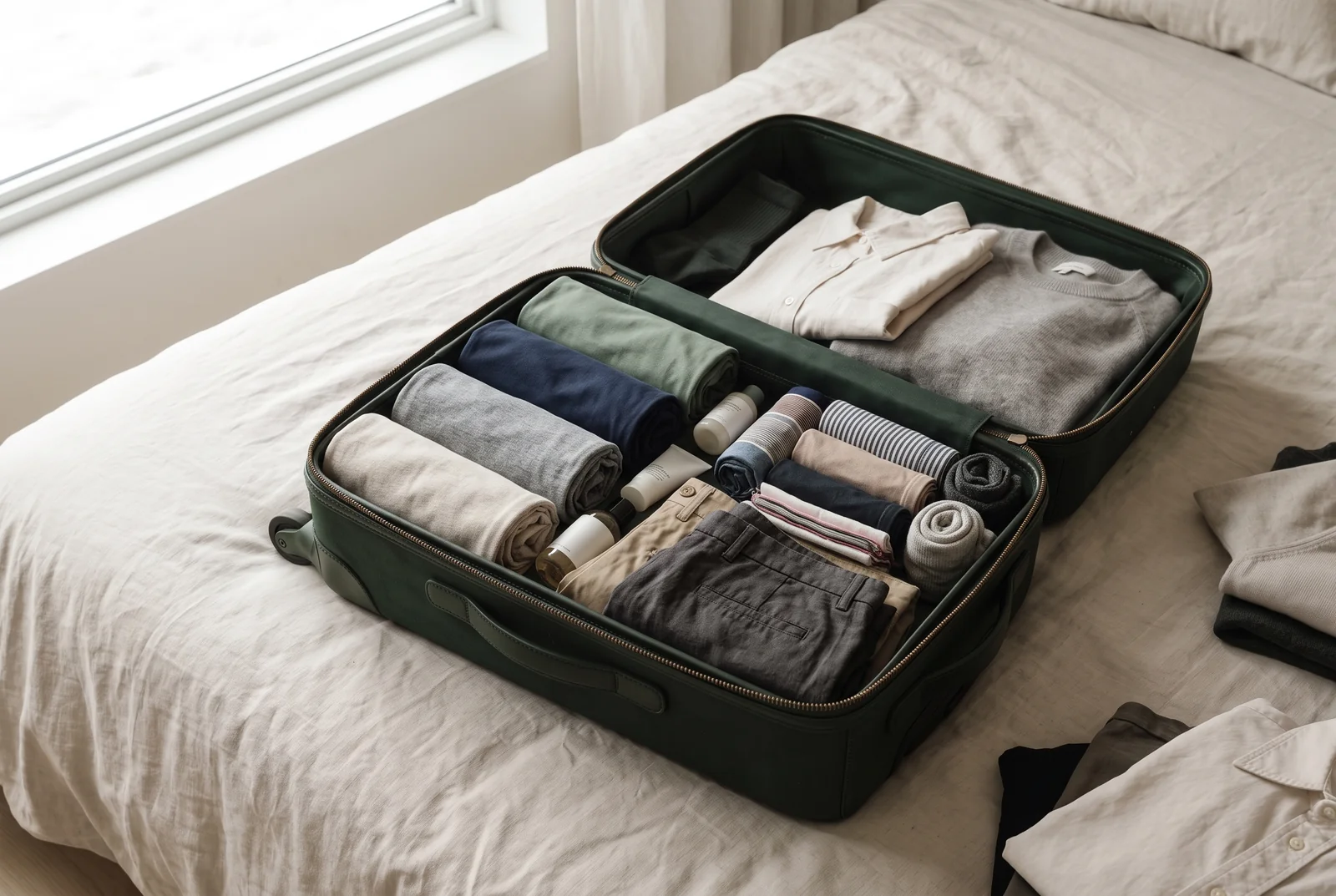
Arrange the items around the bag’s usable interior and the order in which you need them. Use cubes to group clothing, then leave deliberate space for rigid or frequently accessed objects. Filling every compartment is not the goal.
Make the comparison that matters
| Check | What it changes | Your next step |
|---|---|---|
| Interior footprint | Determines which cubes lie flat | Measure around rails and curved corners |
| Opening access | Changes what is easy to reach | Place first-use items deliberately |
| Rigid equipment | Cannot fill every leftover gap | Give it a planned location |
| Worn clothing | Needs a separate return-trip plan | Reserve a reusable compartment or bag |
Measure the useful compartment
Open the case and measure the flat packing area. Note wheel housings, handle tubes and sloping sides. External suitcase volume is not the same as this interior footprint. If the lid holds another packing layer, measure it separately.
Make a paper trial
Draw or cut rectangles for the cubes you are considering using their published dimensions. Arrange them without stretching the case. Leave room for your actual toiletries pouch and shoes. A cube that fills the width perfectly but blocks every other item is not necessarily a good use of space.
Assign a job to every container
Useful groups might be tops, underwear and clothing waiting for laundry. Avoid a separate pouch for every tiny object unless that separation helps you find things. The goal is fewer decisions while packing and unpacking, not a larger collection of organizers.
Weigh the system as a whole
Include all cubes and pouches in the packing planner. If an organizer helps with access, its weight may be worthwhile; if it is empty for half the trip, a simpler layout may serve you better. Try one journey before buying a complete matching set.
Before you spend
Use folded clothing or paper templates to try several arrangements before buying a matching set. Measure the packed cube rather than assuming the flat dimensions describe its final shape. Keep documents and items needed in transit accessible without opening the whole case. At the end, close the bag without forcing the zip and check its exterior again.
A useful finishing check
No. Cubes are most useful when they group items and improve access. A bulky organizer around an already rigid object can add weight and waste space. Start with the clothing groups that benefit, then decide whether further compartments solve a real problem.
ILLUSTRATIVE EXAMPLE
Put it into practice
An illustrative packing layout uses one clothing cube, one smaller underwear pouch and a separate space for shoes. Removing a third cube can improve the fit when it would otherwise bridge a handle rail and force the lid outward. More organization is useful only when it improves the whole pack.
Your next steps
- Map the interior: note rails and corners
- Group by access: plan what comes out first
- Close and measure: check the finished exterior
Questions that come up
Should all cubes be the same size?
No. Start with the bag’s interior footprint and the groups of clothing you need.
Are internal and external litre measurements comparable?
Not necessarily. Measurement methods and unusable space differ; use dimensions and a physical layout check.
Should every item go in a packing cube?
No. Cubes are most useful when they group items and improve access. A bulky organizer around an already rigid object can add weight and waste space. Start with the clothing groups that benefit, then decide whether further compartments solve a real problem.
Sources and further reading
Source references for this edition, September 8, 2026. Recheck changeable rules and the exact product or vehicle instructions before acting.