
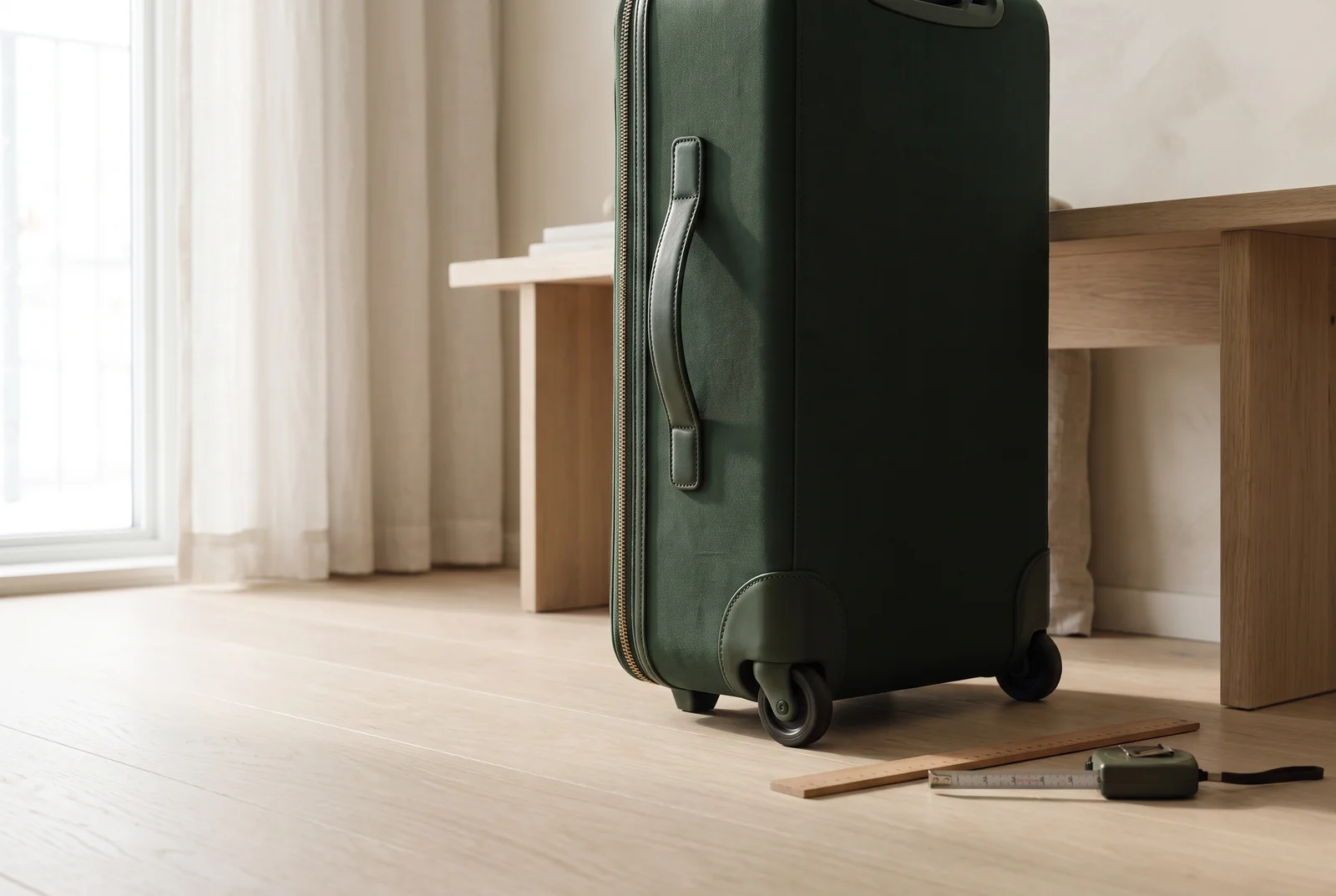
Measure the outside of the packed bag at its widest points, including wheels, handles and filled pockets. Compare all three dimensions with the allowance on your booking; a litre figure cannot establish fit.
Make the comparison that matters
| Check | What it changes | Your next step |
|---|---|---|
| Case body | Can exclude projecting parts | Measure the complete exterior |
| Expansion zip | Adds packed depth | Measure in the position you will travel |
| Soft pocket | Changes shape when filled | Pack it before checking |
| Published inches and cm | May use different rounding | Compare in the source units |
Pack it before you measure
An empty soft bag can be a very different shape from a packed one. Fill it as you would for the trip, close every zip and choose whether the expansion panel will be open. Stand it against a wall so a protruding wheel or handle cannot disappear into a curved tape measurement.
Take three straight measurements
Measure the longest outside distance, then the two remaining perpendicular sides. Include fixed handles, wheels, feet and bulging pockets. A ruler or book held against each outermost point helps create a straight reference. Do not run the tape around the contour of the case.
Record which way the bag was packed. If a laptop or shoe pushes a pocket out, rearrange it and measure again. A little spare room is more useful than an optimistic rounding decision.
Separate a size label from a limit
A “21-inch” model name may refer to the case body. Look for “overall dimensions” on the exact product version before comparing it with an airline. For an illustrative 55 × 40 × 20 cm bag, the linear measurement is 115 cm, or about 45.28 inches. Its rectangular envelope is 44 L, but neither number tells you whether all three sides fit a cabin allowance.
Make the final comparison
Enter all three measurements in the bag-fit tool. Keep the original units used by the airline when a measurement is close to the boundary. Save the operating carrier’s rule with your booking, especially if the trip includes a connection on another airline.
Before you spend
A listing may quote the shell dimensions in one place and overall dimensions in another. Save the exact model name and the overall measurement so you can compare like with like. For a soft bag, check how the seams, padded back and handles behave when packed; compressible clothing does not make every part of the bag compressible. If a seller cannot clarify the measurement, that uncertainty belongs in the purchase decision.
A useful finishing check
Litres describe volume, while an airline rule usually limits separate dimensions. Two bags with the same volume can have very different proportions. Use exterior dimensions for the fit check and capacity only for deciding how much equipment you want to carry.
ILLUSTRATIVE EXAMPLE
Put it into practice
An illustrative bag measures 54 × 35 × 21 cm with its pockets empty. A filled front pocket takes the depth to 24 cm. Against a hypothetical 55 × 40 × 23 cm allowance, the packed bag is 1 cm too deep even though the other dimensions fit. Rotating it does not make that excess disappear.
Your next steps
- Pack the bag: include filled outer pockets
- Measure the exterior: include all projections
- Compare each axis: use the booked allowance
Questions that come up
Do wheels count in luggage dimensions?
Use the full exterior including wheels and fixed handles unless your airline explicitly says otherwise.
Does a 22-inch label guarantee cabin acceptance?
No. The other sides, overall rather than body size, weight and fare entitlement still matter.
Can I use litres to check cabin-bag fit?
Litres describe volume, while an airline rule usually limits separate dimensions. Two bags with the same volume can have very different proportions. Use exterior dimensions for the fit check and capacity only for deciding how much equipment you want to carry.
Sources and further reading
Source references for this edition, September 8, 2026. Recheck changeable rules and the exact product or vehicle instructions before acting.