
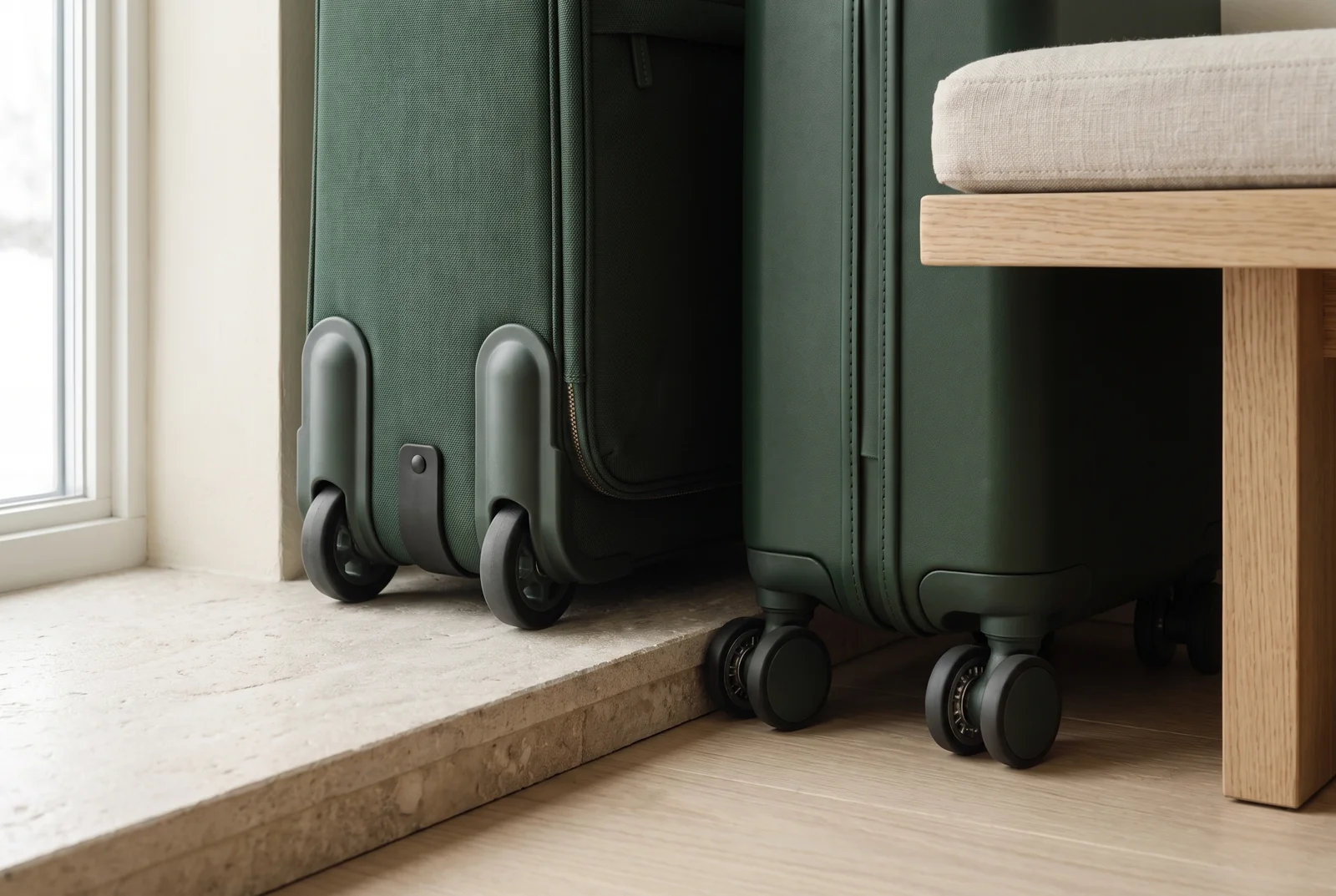
Four-wheel spinners are convenient beside you on smooth surfaces; two-wheel cases are designed to pull behind you. Compare wheel construction, handle comfort, lifting and usable space for your route, rather than assuming a wheel count determines overall quality.
Make the comparison that matters
| Check | What it changes | Your next step |
|---|---|---|
| Smooth floors | A spinner can roll beside you | Test tracking with a packed load |
| Uneven sections | Dragging and lifting become relevant | Check clearance and handle comfort |
| Overall size | Wheels occupy exterior allowance | Compare complete measurements |
| Repair access | Wear parts may need replacement | Check the actual service policy |
Name the route, not a winner
Four-wheel cases can be moved upright on a smooth concourse. A two-wheel case is normally pulled tilted behind you. Pavements, slopes, stairs and train aisles change the practical experience, so consider the full transfer rather than only the airport floor.
Look at wheel position and lift points
Exposed wheels count toward the outer size. Compare how easily you can lift the loaded bag using its top and side handles. For steps and uneven transitions, a manageable packed weight and a reliable grip may matter more than wheel count.
Treat rough ground as a packing constraint
A suitcase is still something you must lift when rolling stops working. If the itinerary includes long uneven walks, compare a smaller case, a different transfer or a comfortably fitted backpack. Avoid buying a larger case simply because the wheels look substantial.
Plan for maintenance
Ask whether the manufacturer provides compatible replacement wheels and who performs repairs. After a trip, remove loose debris according to the bag’s care guidance and inspect for damage. Do not apply an arbitrary lubricant to plastic wheels or bearings without the maker’s advice.
Before you spend
Use comparable case sizes and packed loads in the comparison. A smoothly spinning empty display case tells you little about how the handle feels with your equipment inside. Look at whether the wheels protrude, how the case stands when parked and how comfortably you can lift it. A repairable wheel system is valuable only if the relevant parts and service are actually available for that model.
A useful finishing check
No. Include the wheels and other projecting parts when checking overall dimensions. A case that has a compliant body measurement can still exceed a baggage rule once the full exterior is measured.
ILLUSTRATIVE EXAMPLE
Put it into practice
If your normal trip is an airport, a short taxi ride and a hotel lift, easy movement across smooth floors may dominate. If you regularly pull a bag over uneven paths, try that handling style with a loaded case before choosing. The lifting at stairs remains part of both journeys.
Your next steps
- Identify surfaces: map the difficult sections
- Test loaded handling: check the pull and lift
- Compare exterior size: include the wheel system
Questions that come up
Are two-wheel cases always better for cobblestones?
No universal result follows from wheel count. Wheel construction, packed weight, distance and surface all matter.
Can I convert a two-wheel case into a spinner?
Do not assume the base is designed for it. Ask the manufacturer about compatible parts and repairs.
Can I ignore the wheels when measuring a suitcase?
No. Include the wheels and other projecting parts when checking overall dimensions. A case that has a compliant body measurement can still exceed a baggage rule once the full exterior is measured.
Sources and further reading
Source references for this edition, September 8, 2026. Recheck changeable rules and the exact product or vehicle instructions before acting.