
There is no universal international cabin-bag size. Check the operating airline, fare and each flight segment, and compare all dimensions and any weight limit. A domestic versus international label on a suitcase is only a product description.

Make the comparison that matters
| Check | What it changes | Your next step |
|---|---|---|
| Operating airline | Whose baggage rules need checking | Read the booking for every leg |
| Fare | Which bags are included | Distinguish included items from paid options |
| Dimensions | The packed exterior must fit | Use the airline’s stated units |
| Weight | May be a separate constraint | Weigh the packed bag |
Three checks belong together
A bag needs to fit the dimension limit, any weight limit and the number/type of bags included in the fare. A suitcase meeting the first check may still require a paid overhead allowance. A single itinerary can involve more than one operating airline, so inspect every segment.
Keep the exact published units
Some airline pages publish rounded figures in both centimetres and inches. Our atlas preserves those pairs when available instead of silently treating a rounded conversion as exact. When a bag sits at the boundary, measure carefully and ask the airline rather than relying on a displayed decimal.
Check the ticket before the product page
Start with the booking’s baggage description. Terms such as “Basic,” “Light” and “Priority” have airline-specific meanings. A retailer’s claim that a bag is “international cabin size” is only a general product description, not permission for your flight.
Create a reusable journey note
Record the operating carrier, bag type, three maximum dimensions, any weight cap and where the bag is stored. Keep the source link with the note and check it again before travelling. Then use the bag-fit tool against the relevant profile. Size compliance still does not guarantee overhead space on a full or small aircraft.
Before you spend
Build the itinerary before the luggage shortlist. Include the return and any separately booked connector; a bag that works on the longest flight may be unsuitable on the shorter one. Keep a record of the rule checked and a link to the source so changes can be rechecked before departure. Avoid relying on a remembered chart without its date or fare context.
A useful finishing check
Often you can choose a bag that meets the relevant limits, but check the full itinerary. Meeting a common size does not mean every fare includes a cabin bag or that the bag will remain in the cabin under every operating condition.
ILLUSTRATIVE EXAMPLE
Put it into practice
For hypothetical limits of 55 × 40 × 23 cm on one leg and 56 × 35 × 22 cm on another, a 55 × 35 × 22 cm exterior meets the dimensional intersection. This example does not create an airline policy: fare entitlement, weight and operational handling still need their own checks.
Your next steps
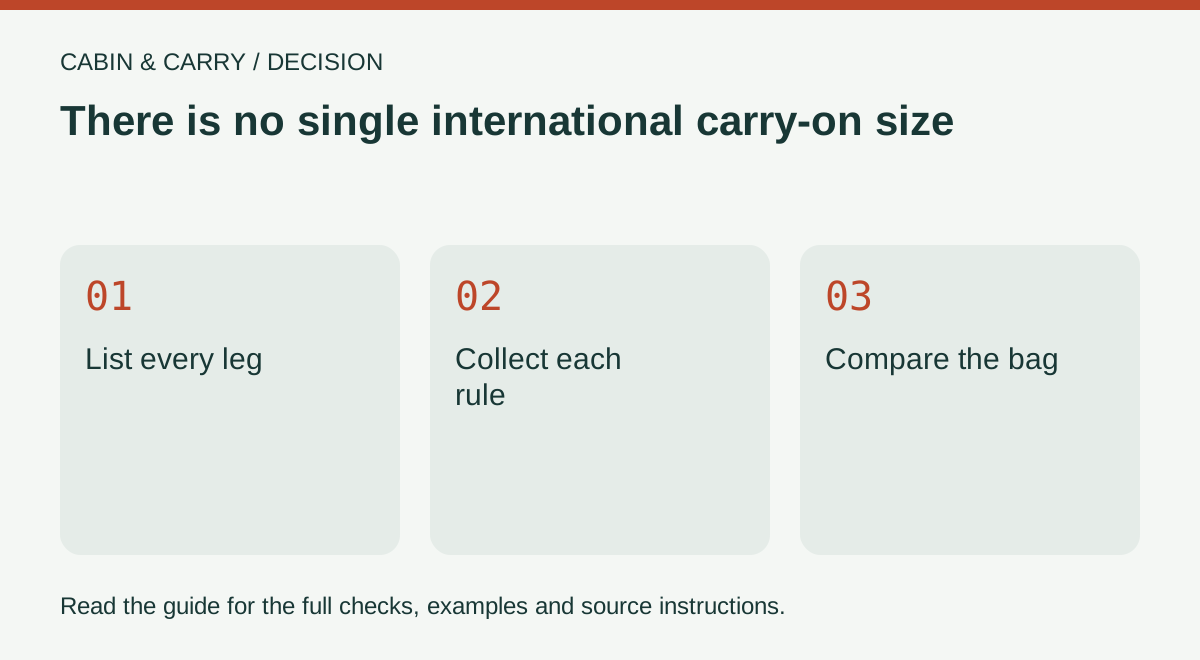
- List every leg: identify the operating carrier
- Collect each rule: include fare and weight
- Compare the bag: use the strictest relevant limits
Questions that come up
Is there a new universal carry-on size?
There is no single size used by all airlines in this atlas. Always check your operating carrier and fare.
Can a cabin bag be gate checked despite fitting?
Yes. Storage and aircraft restrictions can still require gate checking; follow the airline’s instructions.
Can I use one cabin bag across several airlines?
Often you can choose a bag that meets the relevant limits, but check the full itinerary. Meeting a common size does not mean every fare includes a cabin bag or that the bag will remain in the cabin under every operating condition.
Sources and further reading
Source references for this edition, September 8, 2026. Recheck changeable rules and the exact product or vehicle instructions before acting.